Forging vs Casting vs CNC Machining: How Wholesale Buyers Choose the Right Process
Forging vs casting vs CNC machining for wholesale buyers: which process fits high-load parts, complex shapes and tight tolerances — and when to combine them.
Direct answer
Choose forging when the part carries high load and its shape suits a die — flanges, gears, automotive parts and similar high-strength components. Choose casting when the part has a complex shape that would be expensive to machine from solid, and the volume justifies the mould — die casting for thin-walled aluminum or zinc parts at larger batches, gravity casting for thicker sections at moderate volumes, investment casting for complex steel and stainless steel shapes. Choose CNC machining from solid when the quantity is low, the tolerances are tight, the part is a prototype, or the geometry cannot be cast or forged economically. In practice, most wholesale orders are a combination: a cast or forged blank, finished by CNC machining on the functional surfaces to 0.01–0.02 mm. The right question is therefore not “which process is best?” but “which process, or combination, gives this part its function at the lowest practical cost for this annual volume?”
KSHCNC runs all three routes in Kunshan — hot die forging, casting, and CNC machining — under ISO 9001 and IATF 16949, so the casting-versus-forging question is answered by engineers who run both, not by a foundry that only sells castings. For the casting routes in detail, see Die Casting, Gravity Casting or Investment Casting: Which Process Fits Your Part? and Casting Tolerances Explained: What CT Grades Mean and When a Part Needs Machining.
The Short Answer for Wholesale Buyers
Start with three questions, in this order:
- What does the part have to survive? High load, impact or fatigue points toward forging. A complex housing with thin walls and fine detail points toward die casting. A prototype or a part with tight tolerances on every functional surface points toward CNC machining from solid.
- What is the annual volume, not just the first order? Tooling for casting and forging is a real investment, and the per-part savings only pay it back across the volume it was built for. A die-cast part produced in small quantities carries tooling it never amortises; a part machined from solid in the thousands may cost more per part than a cast or forged blank would.
- Which surfaces actually need machining? Functional surfaces — bearing bores, sealing faces, threads, mating datums, gasket grooves — cannot stay as-cast or as-forged if the drawing is honest about their function. Everything that only needs to exist can stay as-cast or as-forged, and every surface left unmachined is machining time saved on every part of every batch.
If you answer those three, the process usually chooses itself. If the answers point in two directions — for example, a high-load part with a complex shape — that is the case for a forged blank finished by CNC machining, or for a casting with machined critical features, and it is worth a manufacturability review before the drawing is frozen.
Forging: For High-Load Parts
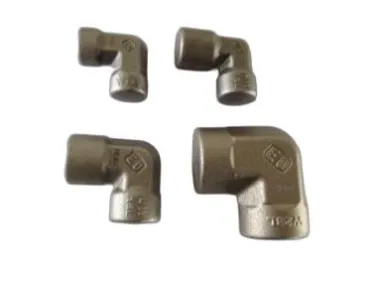
Hot die forging shapes heated metal in a die under a hammer or press. KSHCNC’s forging capability covers hot die forging and stamping of flanges, inserts, fittings, gears, bridge parts, lever turbine actuators and turbocharger components in steel, brass and aluminum, on a 31.5 kJ hammer, a 630T screw press, a 500T hydraulic press and 630T/400T presses.
Buyers choose forging when:
- The part carries high load — flanges, gears and automotive parts are the classic examples on KSHCNC’s forged-parts range.
- The shape is suited to a die, without the thin walls or fine internal detail that casting handles better.
- The volume justifies the die, and the part will be finished by CNC machining on its functional surfaces.
Forging is not the route for a thin-walled housing, a part with complex internal shapes, or a one-off prototype where the die cost would dominate the order. And a forged blank is not a finished part: its critical bores, faces and threads still need CNC machining, to the tolerances on the drawing.
If the part carries high load, ask whether a forging would serve better than a casting — the honest answer sometimes is not a casting at all. That is the advice in KSHCNC’s own casting guide, and it is the reason to get the process decision reviewed by a supplier who runs both routes.
Casting: For Complex Shapes at Volume
Casting is not one process but a family of them, and the wrong choice shows up later as excess cost. KSHCNC supplies die castings in aluminum and zinc, gravity castings, and investment castings in steel and stainless steel, all finished in its own CNC machining operation.
High-pressure die casting forces molten aluminum or zinc into a steel mould at high speed. It produces thin-walled, dimensionally consistent parts with excellent surface finish, and once the mould exists, each part is cheap — which is why it rewards larger batches.
Gravity casting pours metal into a permanent mould without pressure: slower and coarser than die casting, but with far cheaper tooling, which makes it the economical route for thicker sections and moderate volumes.
Investment casting (lost-wax) builds a ceramic shell around a wax pattern and delivers complex geometries in steel and stainless steel that no other casting route can reach.
Choose by material first, because it eliminates options quickly: aluminum and zinc point to die or gravity casting; steel and stainless steel point to investment casting. Then geometry: very thin walls and fine detail need die-casting pressure; thick, simple sections tolerate gravity casting; undercuts and complex internal shapes favour investment casting. Finally batch size, which decides the economics — annual demand, not the first order, should drive this calculation.
Casting tolerances are the part buyers most often misunderstand. Cast dimensions are specified in casting tolerance (CT) grades — a standardised scale that accounts for shrinkage, mould wear and process variation. Within a normal grade, a bore might come out several tenths of a millimetre from nominal, and that is not a defect: it is what the process is built to deliver. Expecting machined-class tolerances from an as-cast surface leads either to disappointment or to unnecessary grinding cost. Mark which surfaces will be machined afterwards and which stay as-cast; casting tolerances on machined-away areas waste money twice.
CNC Machining From Solid: For Precision, Prototypes and Low Volume
CNC machining from solid bar, plate or extruded profile is the route with no mould and no die. KSHCNC machines on 68 CNC machines, including 30 CNC lathes and Mazak, Okuma and HAAS machining centers, with CNC turning, milling, drilling, tapping and precision threading, and machining tolerances to 0.01–0.02 mm depending on part geometry.
Buyers choose machining from solid when:
- The quantity is low, or the part is a prototype — there is no tooling to amortise, so the first part costs roughly the same per part as the tenth.
- Tolerances are tight on many surfaces, not just one or two functional faces.
- The geometry is complex in a way that suits milling and turning, or it changes frequently between orders.
- The material is a specific grade or temper — for example, 6061-T651 plate for a flat housing where residual stress and flatness matter — that is best bought as wrought stock, not cast or forged.
Machining from solid is not the economical route for a high-volume part with a simple, bulky shape. Machining a component from an oversized block may generate substantial material waste, and that waste becomes more expensive when using a higher-cost alloy. That is the point at which a cast or forged blank, close to the final shape, starts to pay.
For the machining process itself, see Custom CNC Machining Process: From Enquiry to Delivery and the general How to Choose the Right Material for Custom CNC Machined Parts.
The Combination Most Buyers Actually Order: Cast or Forged Blank, CNC Finished
Most wholesale KSHCNC orders are not one process alone. They are a blank made by casting or forging, with the functional surfaces finished by CNC machining.
That combination works when casting and machining — or forging and machining — sit under one quality system. The machining allowances are planned into the mould or die design from the start: cast the blank so it machines well. When casting and machining are bought from separate suppliers, the machinist receives castings whose variation someone else controls, and every deviation becomes a fitting problem at the machining stage. When both sit under one system, there are fewer datum transfers, no cross-supplier finger-pointing, and inspection documentation that covers the part from melt to final dimension.
In KSHCNC’s casting projects, that means a manufacturability review and tooling development before first samples, and samples that are machined, inspected and approved before the batch runs — so the tooling is proven before it is paid off. The same logic applies to forgings: the die, the blank and the machining plan are reviewed together, not in sequence.
Practically, divide the drawing explicitly: mark machined surfaces and their tolerances, and leave as-cast or as-forged surfaces to their standard grades — do not copy one tight tolerance across the whole part. State which surfaces are datums, because the machining operation will be built around them. If a cosmetic surface must look good as-cast, say so; surface expectations are part of the tolerance conversation. And confirm that material certificates and dimensional reports will reference the final, machined state of the part.
What Decides the Cost: Tooling, Volume and Tolerances
Three factors decide the cost more than the headline process name:
Tooling and its amortisation. Die casting and gravity casting both need permanent tooling, and forging needs a die. A mould or die designed without machining allowances in mind will produce blanks whose critical features cannot be finished economically. State the annual volume, not just the first order — it may change the recommended process entirely.
Material and utilisation. Common grades cast, forge and source faster than special grades. A part machined from solid from an oversized block wastes material on every part; a near-net-shape cast or forged blank wastes less, but carries tooling. The balance point moves with volume, and it is worth asking the supplier to show it for your annual quantity, not just for the first batch.
Tolerances and inspection. A drawing tolerance of 0.02 mm does not simply transfer to a cast or forged part. Castings and machined surfaces obey different tolerance worlds. Applying a machined tolerance to a whole cast part, or a casting tolerance to a bearing bore, both cost money — one in grinding, the other in a part that does not fit. Quality control at KSHCNC includes first article inspection, in-process checks and final dimensional inspection, under ISO 9001 and IATF 16949, with inspection reports and material certificates provided according to project requirements.
A Side-by-Side Comparison for Buyers
Decision point | Forging | Casting | CNC machining from solid |
|---|---|---|---|
Best for | High-load flanges, gears, automotive parts, fittings | Complex housings, thin-walled parts, complex steel shapes | Prototypes, low volume, tight tolerances, frequent design changes |
Typical KSHCNC range | Steel, brass, aluminum; 31.5 kJ hammer, 630T / 500T presses | Die casting (Al, Zn), gravity casting, investment casting (steel, stainless) | Brass, aluminum, stainless, carbon / alloy steels; 68 CNC machines |
Tooling | Die required; cost amortised over volume | Mould required; die casting mould is the largest investment | No mould or die |
Tolerances as-produced | Coarser than machined; functional surfaces need CNC finishing | CT grades; several tenths of a millimetre variation is normal as-cast | 0.01–0.02 mm on machined surfaces, depending on geometry |
Volume where it pays | Moderate to high, for high-load parts | Moderate to high, especially die casting at larger batches | Low to moderate, and prototypes at any volume |
Watch out for | Die cost on low volumes; shape must suit a die | Tooling cost on small batches; do not specify machined tolerances as-cast | Material waste from solid block on bulky, high-volume parts |
Combine with | CNC finishing on bores, faces, threads | CNC finishing on functional surfaces | — or start from a cast / forged blank |
How to Specify the Process on a Drawing
Do not write only “forged” or “cast” on the drawing and leave the rest to be guessed. Include:
- 2D/3D drawings (PDF, STEP or STP), with machined surfaces marked and their tolerances stated separately from as-cast / as-forged surfaces
- Material grade and standard (GB, ASTM or EN), because the material certificate must match it
- First order quantity and expected annual volume
- Working conditions: load, environment, temperature, and any safety or certification requirement
- Which surfaces are datums, which are cosmetic, and which are functional — bearing bores, sealing faces, threads, mating faces, gasket grooves
- Whether the part will be heat treated or coated afterwards, because the pre-treatment stock size and final dimensions both depend on it
If you are unsure which process fits, send the drawing with the quantities and the working conditions, and ask for a manufacturability review before the tooling is ordered. That review is where a forging-versus-casting mistake is cheapest to catch.
Wholesale Buying Checklist
- Function first: high load → consider forging; complex shape → consider casting; prototype / tight tolerances / low volume → consider machining from solid.
- Annual volume stated, not just the first order — it can change the recommended process entirely.
- Machined surfaces marked separately from as-cast / as-forged surfaces, with their own tolerances.
- Material grade and standard specified; common grades cast, forge and source faster.
- Tooling reviewed with machining allowances in mind, before first samples.
- Samples machined, inspected and approved before the batch runs.
- Material certificates and dimensional reports confirmed for the final, machined state.
Frequently Asked Questions
Can a part be both forged and CNC machined?
Yes — that is the normal route for high-load parts. The forging provides the blank, and CNC machining finishes the bores, faces and threads to the drawing tolerances. The same applies to castings: a cast blank, CNC finished on its functional surfaces.
Is forging always stronger than casting?
Not as a blanket claim, and it should not be specified that way. Forging is the route buyers choose for high-load parts such as flanges, gears and automotive components, and casting is the route for complex shapes at volume. The right choice depends on the part’s load, shape, material and volume — send the drawing and the working conditions and KSHCNC will review which process fits that part.
When should I not use die casting?
When the volume is small, the die cost will dominate the order, or when the material is steel or stainless steel — those point to investment casting, not die casting. A die-cast part produced in small quantities carries tooling it never amortises.
Why does my casting drawing need machining allowances?
Because as-cast dimensions vary by CT grade, and functional surfaces need machining to reach 0.01–0.02 mm. If the mould is designed without machining allowances, the critical features may not have enough material left to finish economically. Plan the allowances at the tooling stage.
Should I order a sample first?
For a new casting or forging, yes. Samples are machined, inspected and approved before the batch runs, so the tooling is proven before it is paid off. Sample costs, lead times and pricing are evaluated according to the project.
Get a process recommendation
Send KSHCNC the drawing, the material and standard, the first order and annual quantities, and the working conditions. KSHCNC will review whether forging, casting, CNC machining from solid, or a cast / forged blank finished by CNC machining fits the part, and reply with a quotation for the actual geometry.
- Forged parts: Hot Die Forged Flanges, Gears & Automotive Parts
- Cast-machined parts: Custom Alloy Die Casting Components and Aluminum Die Cast Housings
- CNC machining: Custom CNC Machining Services
- Contact: Contact KSHCNC
KSHCNC is a precision manufacturing company founded in Kunshan, China, in February 2005. It manufactures forgings, castings and CNC machined parts on 68 CNC machines including 30 CNC lathes and Mazak, Okuma and HAAS machining centers, with hot die forging on a 31.5 kJ hammer, 630T screw press, 500T hydraulic press and 630T/400T presses, and machining tolerances to 0.01–0.02 mm depending on part geometry, under ISO 9001 and IATF 16949 quality management systems. Learn more on the About KSHCNC page.