Hydraulic Valve Replacement Guide for Repair Shops: Identify, Match and Install Without Downtime
Replace a failed proportional or servo valve without long downtime. Read the nameplate, diagnose the fault, confirm the fit, and install it right the first time.
Direct Answer
A failed proportional or servo valve does not have to mean a week of downtime. In most repair jobs, the fastest route is: photograph the nameplate, record the NG size and spool and electrical details, check whether the fault is mechanical, electrical, or contamination-related, and confirm that the replacement mounts on the same interface. If those four points match, a drop-in replacement can usually be fitted without modifying the manifold — but compatibility must be confirmed before replacement.
How to Read a Valve Nameplate and Identify the Model and Size
Start with the nameplate, not with a guess from the machine manual. Photograph it straight on, in good light, before you remove the valve. Oil, paint, and wear often hide one character, and one wrong character can mean the wrong spool or the wrong electronics.
Record these fields, exactly as printed:
- Manufacturer and model code. This is the primary identifier. Copy the full code, including suffixes. A suffix often encodes the spool type, the electronics, or the electrical connector.
- NG size. NG6, NG10, NG16, and NG25 are the common mounting sizes for proportional and servo valves. The NG size determines the mounting pattern and the port layout. For example, the JINFA VED03MX is an NG6 valve, and the JINFA VED series covers NG6 to NG25. Do not assume size from the physical length of the valve alone — measure the mounting face and the port spacing.
- Flow and pressure ratings. Note the rated flow and the maximum working pressure printed on the plate or in the datasheet. The JINFA VED series, for example, is rated for a maximum working pressure of 350 bar and is factory pressure-tested up to 450 bar. A replacement must meet or exceed the working pressure of the circuit it serves.
- Spool type and overlap. If the code or datasheet states it, note whether the spool is zero-lap, positive-overlap, or another type. A zero-lap spool responds around null with minimal deadband, which matters for closed-loop control. A positive-overlap spool holds position but adds deadband. This is one of the details that is easy to get wrong when ordering a visually similar valve.
- Electrical data. Record the supply voltage, the command signal type, and the connector type. Proportional and servo valves are not interchangeable on electrical grounds alone: a valve with the right hydraulics and the wrong input signal will not control correctly.
- Serial number and date code. Keep these with the job record. They help the supplier trace the exact build and, if the valve has been repaired before, what was changed.
If the nameplate is unreadable, photograph the mounting face, the electrical connector, and any casting marks on the body, and note the machine type and the axis the valve controls. That information is often enough for a supplier to narrow the options, but it is not a substitute for the model code.
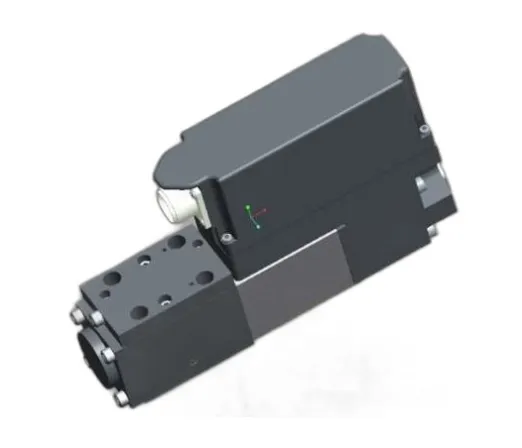
JINFA VED03MX proportional servo valve, NG6 — the replacement discussed in this guide.
Spool Sticking, Electrical Fault, or Contamination? How to Tell Them Apart
Replacing the valve will not fix the machine if the fault is elsewhere. Before you order, spend 15 minutes separating the three most common causes.
Spool sticking — mechanical. The classic signs are slow or jerky movement, a deadband that has grown over time, and an axis that sticks in one position and then jumps. The spool may move freely when the valve is removed and stroked by hand, or it may bind at one point in its travel. Spool sticking is often linked to contamination, varnish, or wear, but it can also follow a period of standing idle. If the spool binds, check the oil condition and the filtration before fitting a new valve, or the replacement may suffer the same fate.
Electrical fault. If the axis does not respond at all, or responds only in one direction, check the electrical side first. Measure the command signal at the valve connector and compare it with the expected value. Check the coil or solenoid resistance against the datasheet, look for a damaged connector or a broken wire, and confirm that the amplifier or driver is supplying power. A valve that is electrically dead is a different job from a valve that is mechanically stuck, and the test takes minutes with a multimeter.
Contamination. Contamination can look like either of the above. Fine particles can jam a spool; water in the oil can cause corrosion and erratic movement. Check the oil sample if one is available, look at the filter condition indicator, and note the ISO cleanliness class if it is recorded. Servo valves typically demand very clean oil, often around ISO 4406 class 14/11 or better. Direct-operated proportional valves generally tolerate typical industrial cleanliness classes better, but no valve will survive sustained contamination. If the oil is visibly dirty or the filter has bypassed, clean the system and change the filter as part of the repair, not as an afterthought.
A short note in the job file — “spool binds at mid-stroke, coil resistance normal, oil dark, filter indicator red” — is worth more than a long description later. It is also the information a supplier needs to confirm that a proportional servo valve, rather than a like-for-like servo valve, is the right replacement.
For the background on the two valve families, see Servo Valve vs Proportional Valve: Key Differences Explained. The practical point for repair work is simple: compare hysteresis, step response, and repeatability at the actual pressure and flow, not only the family name.
How to Confirm the Mounting and Interface Without Modifying the Manifold
The fastest replacement is one that fits the existing manifold. Modifying a manifold adds machining time, introduces a leak risk, and is often unnecessary.
Check these points against the datasheet of the proposed replacement:
- Mounting pattern and port positions. Compare the NG size and the port layout on the mounting face. The bolt pattern, the P, T, A, and B port positions, and any drain or pilot ports must line up. A valve that is one NG size up or down will not fit, even if the body looks similar.
- Overall height and clearance. Check the height of the valve, including the solenoid or amplifier housing, against the space above the manifold. A taller valve can foul a cover, a pipe, or a neighbouring component.
- Electrical connector position and type. Confirm that the connector faces the same way and that the existing cable reaches it. A connector on the opposite side can turn a 30-minute job into a rewiring job.
- Spool and flow match. Confirm the rated flow at the working differential pressure. The JINFA VED03MX, for example, is rated at 2–40 L/min at 70 bar differential, with hysteresis of less than 0.1%. A valve with too little flow will starve the axis; a valve with far too much flow can make the axis difficult to control.
- Feedback type. Note whether the original valve used open-loop solenoid control or closed-loop spool-position feedback, such as an LVDT. JINFA VED proportional servo valves use integrated LVDT closed-loop control and a zero-lap spool. If the machine’s controller expects LVDT feedback, the replacement must provide it in a compatible form.
If any of these points do not match, do not force the fit. Send the nameplate and the mounting measurements to the supplier and ask for a confirmed match. For the manifold question in detail, see Replace OEM Proportional Valves Without Manifold Modification. Compatibility must be confirmed before replacement.

Check pressure and gauge readings before deciding whether the valve or the circuit is at fault.
What to Photograph and Send for a Replacement Recommendation
A good recommendation needs four things. Send them together, in one message, and the supplier can usually respond without a second round of questions.
- The nameplate, straight on and legible. Include the full model code, serial number, and any rating plates.
- The mounting face and the electrical connector. Photograph the valve from the mounting side if it is already removed, and the connector from the cable side.
- The machine and the axis. State the machine type — for example, injection moulding, press, or mobile machine — and which axis the valve controls. The duty cycle and the required dynamics are different for a clamp axis and a general motion axis.
- The symptoms and the test results. Note what the machine does, what you measured, and what you have already checked. Include the working pressure and flow if known, and the oil cleanliness class if recorded.
Do not send only a photo of the outside of the valve with no model code. That is the most common cause of a delayed or wrong recommendation.
Installation and First-Start Checks
Fit the replacement on a clean manifold face. Replace the O-rings, check that they sit in the correct grooves, and torque the mounting bolts in the pattern and to the value in the datasheet. Do not reuse a flattened or cut O-ring.
Before first start, flush the lines if the system has been open, check the oil level and the filter, and confirm the electrical connections. On first start, run the axis slowly and watch for three things: smooth movement without sticking, no external leakage at the mounting face, and a stable null position with no drift. If the axis drifts or hunts, stop and check the null adjustment, the command signal, and the feedback wiring before running at full speed.
Record the new valve’s model, serial number, and installation date in the machine file. The next repair will be faster because of it.
Repair-Shop Replacement Checklist
| Step | Check | Done |
|---|---|---|
| 1 | Photograph the nameplate and record the full model code | ☐ |
| 2 | Record NG size, flow, pressure, spool type, and electrical data | ☐ |
| 3 | Test: spool movement, coil resistance, command signal | ☐ |
| 4 | Check oil condition and filter indicator | ☐ |
| 5 | Confirm mounting pattern, port layout, height, and connector | ☐ |
| 6 | Confirm flow at working differential pressure and feedback type | ☐ |
| 7 | Get a confirmed compatibility check before ordering | ☐ |
| 8 | Fit new O-rings, torque bolts to datasheet value | ☐ |
| 9 | First start at low speed: check movement, leaks, and null | ☐ |
| 10 | Record new model, serial number, and date in the machine file | ☐ |
Frequently Asked Questions
Can I replace a servo valve with a proportional servo valve?
Sometimes, but not by family name alone. Compare the mounting size, flow, pressure, spool overlap, response, and feedback type. Many modern proportional valves include spool-position feedback that was once a servo-valve feature. Compatibility must be confirmed before replacement.
How do I know the NG size if the nameplate is unreadable?
Measure the mounting face: the bolt pattern and port spacing define the NG size. Photograph the mounting face and the electrical connector and send them with the machine type and axis. A supplier can usually identify the size from those measurements.
The new valve fits, but the axis drifts at null. What should I check first?
Check the null adjustment, the command signal at zero, and the feedback wiring. Also check for a sticking spool or contaminated oil. Do not run the machine at full speed until the null is stable.
Do I need to modify the manifold for a JINFA VED replacement?
Not in most cases where the NG size and interface match. JINFA VED valves are designed as proportional servo valves from NG6 to NG25, and the aim is a drop-in fit on the existing mounting. Confirm the mounting, flow, and electrical interface against the datasheet first — compatibility must be confirmed before replacement.
Get a replacement recommendation
Have a valve model or a nameplate photo? Send us your application details or the existing valve nameplate, and we will reply with an initial recommendation within 24 hours. Contact KSHCNC
KSHCNC is a precision manufacturing company founded in Kunshan, China, in February 2005. It manufactures JINFA proportional servo valves with in-house machining, forging, assembly, and testing, and operates under ISO 9001 and IATF 16949 quality management systems, with 68 CNC machines. Learn more about the company on the About KSHCNC page, or see the JINFA VED03MX Proportional Servo Valve NG6.