Hydraulic Valves for Excavators: Choosing Proportional and Servo Valves for Mobile Machinery
Choosing an excavator hydraulic valve? Compare proportional vs servo valves, NG sizing, and replacement checks for travel, swing and boom functions.

Direct Answer
For most excavators, a proportional valve is the right choice for travel, swing, boom, arm and bucket control, while servo-grade performance is only needed where closed-loop position or force control demands very low hysteresis and fast response. Choose the NG size by flow and cylinder size, not by machine weight alone, check mounting, spool type and electronics before ordering, and confirm compatibility before replacing a valve. JINFA VED proportional servo valves cover NG6 to NG25, with LVDT closed-loop control, a zero-lap spool and a maximum working pressure of 350 bar.
How Mobile Hydraulics Differ from Industrial Hydraulics
An excavator is not a factory machine that happens to move. Its hydraulic system works outdoors, on uneven ground, with a diesel engine that changes speed, a pump that must serve several functions at once, and an operator who expects smooth, predictable movement from the first hour of a cold morning to the last hour of a hot afternoon.
In a factory, oil temperature, cleanliness and load are relatively stable. On an excavator, they are not. Oil heats up during continuous digging, cools during idle periods, and is exposed to dust, water and vibration. Hoses flex, fittings loosen, and the machine itself tilts. A valve that performs well on a test bench can still feel harsh, slow or unstable in the field if it was selected only on catalogue flow and pressure.
Mobile systems also share flow. Travel, swing and digging functions often draw from the same pump circuit, so a valve must meter flow smoothly when another function starts or stops. A sudden change in load — for example, when a bucket breaks out of hard ground — should not cause a jerk in the boom or a loss of swing control. That is why spool overlap, metering characteristics and feedback matter as much as the nominal size printed on the nameplate.
For manufacturers, this means the valve is part of the machine’s feel, not just a component that opens and closes. For repair providers, it means a replacement valve must match the original behaviour in the machine, not only its mounting dimensions.
An excavator at work — travel, swing and digging functions all depend on reliable hydraulic valves.
Which Excavator Functions Need Servo-Grade Performance — and Which Do Not
The terms servo valve and proportional valve are often used interchangeably, and modern designs blur the line. The practical question for an excavator is simpler: how much precision, speed and repeatability does this function actually need?
Travel and swing are the clearest examples of functions where a good proportional valve is usually sufficient. Travel needs smooth starting, stopping and straight-line tracking. Swing needs controlled acceleration and braking so the upper structure does not overshoot. Both benefit from proportional metering and, where fitted, spool-position feedback, but they do not normally need the very fast response and very low hysteresis of a classic two-stage servo valve.
Boom, arm and bucket functions sit in the middle. Digging and grading need fine metering around the neutral position so the operator can make small, controlled movements. A zero-lap spool helps here because it responds around null with minimal deadband. A positive-overlap spool holds position more firmly but adds deadband, which the operator feels as a delay before movement starts. For most digging work, a proportional servo valve with LVDT closed-loop control gives a useful balance: better repeatability than an open-loop proportional valve, without the cost and cleanliness demands of a full servo valve.
Servo-grade performance becomes worth considering where the machine uses closed-loop position or force control with high dynamic requirements — for example, a grading or lifting function that must hold a precise position under changing load, or a test and calibration setup rather than normal digging. In those cases, look at the actual performance figures — hysteresis, step response and repeatability at the working pressure and flow — rather than the family name on the datasheet.
The distinction is explained in more detail in Servo Valve vs Proportional Valve: Key Differences Explained. The key point for excavators is not to pay for servo performance where proportional control will do, and not to fit a basic proportional valve where closed-loop control is required.
Sizing by Function: NG6, NG10, NG16 and NG25
NG size is a mounting and flow class, not a quality grade. A larger NG valve does not automatically give better control; it gives more flow capacity at a given pressure drop. Oversizing a valve can make fine metering harder, while undersizing it causes excessive pressure drop, heat and slow movement.
Use the table below as a starting point, then confirm the choice against the rated flow, pressure drop and spool type on the specific valve datasheet and the cylinder or motor it will drive.
| Function | Typical starting point | What to check |
|---|---|---|
| Pilot and small auxiliary functions | NG6 | Low flow, compact mounting, spool and electronics match |
| Swing and smaller boom/arm functions | NG6–NG10 | Flow at working pressure, metering around null, braking behaviour |
| Main boom, arm and bucket | NG10–NG16 | Cylinder size, required speed, pressure drop at rated flow |
| Large boom, travel motors and high-flow functions | NG16–NG25 | Maximum flow, pressure drop, heat and pump capacity |
The NG sizes themselves are discussed in NG6, NG10, NG16 and NG25 Hydraulic Valve Sizes. Do not select by NG size alone. Two valves with the same NG mounting can have different spool types, flow ratings and electronics, and those differences determine how the machine behaves.
As a reference point, the JINFA VED03MX Proportional Servo Valve NG6 is a direct-operated valve with a spool-sleeve structure, integrated amplifier and LVDT position sensor, a zero-lap spool and fail-safe position. Its rated flow is 2–40 L/min at 70 bar differential, with hysteresis below 0.1%. That combination — small size, closed-loop feedback and low hysteresis — is useful where fine control matters in a compact mounting. For larger functions, the VED07MX Two-Stage Proportional Servo Valve NG16 is the larger NG16 option in the same VED family. Check the datasheet for each model before ordering; do not assume the flow, spool or electronics of one model apply to another.
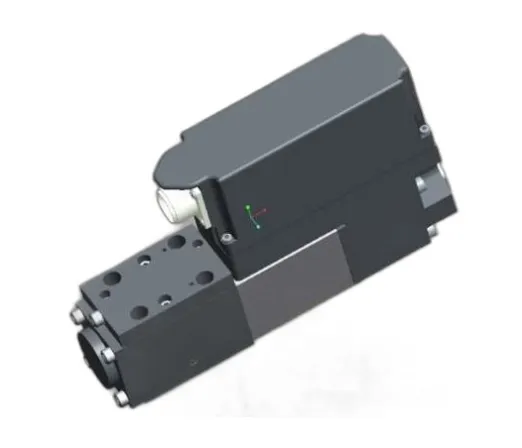
JINFA VED03MX NG6 proportional servo valve with LVDT closed-loop control and zero-lap spool.
Contamination, Vibration and Temperature in the Field
Contamination is the most common cause of valve problems on excavators, and it is also the most avoidable. Dust enters through breathers and seals, water condenses in the tank, and wear particles circulate if filtration is poor. A classic servo valve, with its fine pilot stage and tight clearances, demands very clean oil. A direct-operated proportional valve tolerates typical industrial cleanliness classes better, and a two-stage proportional valve with spool-position feedback sits between the two.
That does not mean filtration can be ignored. Before fitting a replacement valve, check the oil cleanliness, the condition of filters and the last oil-change interval. If the oil is visibly dirty or the filters are overdue, fitting a new valve into the same oil will shorten its life. Photograph the oil sample and filter condition during the repair; it is useful evidence if the valve later shows sticking or slow response.
Vibration is the second field factor. An excavator valve is bolted to a manifold on a machine that shakes, tilts and travels over rough ground. Electrical connectors, amplifier housings and LVDT cables must be secured and protected from chafing and water. When replacing a valve, check the connector type and pin layout against the original, and confirm that the cable routing does not pull tight at full boom or swing travel.
Temperature is the third. Cold oil is thick and slow; hot oil is thin and can increase internal leakage. A valve that feels sluggish on a cold start may be normal until the oil warms up, while a valve that drifts when hot may point to wear, contamination or an incorrect spool choice. Record the oil temperature when the fault appears. That one detail often separates a valve fault from a pump, filter or control problem.
Replacement in the Field: What to Check Before Ordering
A field replacement fails most often before the new valve arrives — because the wrong mounting, spool or electronics were ordered. Work through the checks below before placing the order, and keep the old valve and its nameplate until the replacement is tested.
First, photograph the nameplate. The model code encodes the spool type, electronics and sometimes the flow rating. A visually similar valve with a different spool or control behaviour will fit the manifold but will not control the machine in the same way.
Second, confirm the mounting. Check the NG size, the port pattern, the bolt pattern and the overall envelope. Some valves look interchangeable but differ in port position or in the space needed for the amplifier and connector. Measure the clearance around the manifold, especially where hoses and adjacent valves limit access.
Third, confirm the spool type. Zero-lap, positive-overlap and underlap spools behave differently around null. If the original spool type is unknown, note how the function behaved before failure: did it creep, did it have deadband, did it hold position when the lever was centred? That behaviour is a clue to the spool that was fitted.
Fourth, confirm the electronics and feedback. Is the valve open-loop solenoid controlled, or does it use LVDT spool-position feedback? What is the supply voltage, the command signal and the connector type? A valve with the right hydraulics but the wrong electronics will not work with the machine controller, and changing the controller to suit the valve is rarely the right repair.
Fifth, confirm the pressure and flow. Check the maximum working pressure, the rated flow at the relevant pressure drop, and the function the valve will drive. JINFA VED proportional servo valves have a maximum working pressure of 350 bar and are factory pressure-tested up to 450 bar, but the correct model still depends on the function, flow and spool required. Compatibility must be confirmed before replacement; do not assume a valve is a direct replacement from mounting size alone.
Finally, plan the first test. After fitting, run the function slowly, check for leaks at the manifold, confirm that the spool returns to neutral, and test the function under light load before full digging. If the machine has closed-loop control, check the feedback signal and calibration before returning it to work.

Field conditions — dust, vibration and temperature swings — determine how a mobile hydraulic valve performs.
Pre-Order Checklist
Use this checklist before ordering a replacement excavator valve:
- ☐ Excavator make, model, year and function (travel, swing, boom, arm, bucket, auxiliary)
- ☐ Photograph of the existing valve nameplate, front and side
- ☐ NG size and mounting / port pattern confirmed
- ☐ Spool type noted, or previous behaviour around null described
- ☐ Electronics: LVDT feedback or open-loop, supply voltage, command signal, connector type
- ☐ Maximum working pressure and rated flow for the function
- ☐ Oil cleanliness and filter condition checked
- ☐ Clearance around the manifold measured for amplifier and connector
- ☐ Compatibility confirmed with the supplier before ordering
If any item on this list is unknown, send what you do have — especially the nameplate photograph — rather than guessing. A short delay for confirmation is cheaper than a second replacement and a second period of downtime.
Frequently Asked Questions
Can I replace a servo valve with a proportional valve on an excavator?
Sometimes, but not by mounting size alone. A proportional servo valve with LVDT feedback can replace a servo valve on many functions, but you must compare hysteresis, step response, repeatability, spool type and electronics at the actual working pressure and flow. If the function uses closed-loop control, confirm that the replacement supports the same feedback and command signal.
What NG size do I need for a boom or bucket function?
It depends on cylinder size and required speed, not on machine weight alone. Smaller functions often start at NG6 or NG10, main boom and bucket functions at NG10 or NG16, and high-flow functions at NG16 or NG25. Confirm the rated flow and pressure drop on the datasheet for the specific model.
Why does my excavator valve stick or respond slowly?
Contamination is the most common cause, followed by worn spools, poor filtration and incorrect oil temperature. Check oil cleanliness, filters and oil temperature first, and check whether the fault appears when cold, when hot, or all the time. Do not replace the valve until the cause is identified, or the new valve may fail in the same way.
Do I need to modify the manifold to fit a JINFA VED valve?
In many replacement cases, no manifold modification is required if the NG mounting, port pattern and spool type match. That must be confirmed for each machine and valve combination before ordering. Send the excavator model, function and existing valve nameplate so the match can be checked.
Get a Recommendation for Your Excavator
If you are replacing a valve on an excavator, send KSHCNC the excavator make and model, the function the valve controls, and a photograph of the existing valve nameplate. KSHCNC, founded in Kunshan, China in February 2005, manufactures JINFA proportional servo valves from NG6 to NG25 and supports customers under ISO 9001 and IATF 16949 quality management systems. The team will reply with an initial recommendation based on the information provided.
Send your excavator model, function and valve nameplate to KSHCNC